
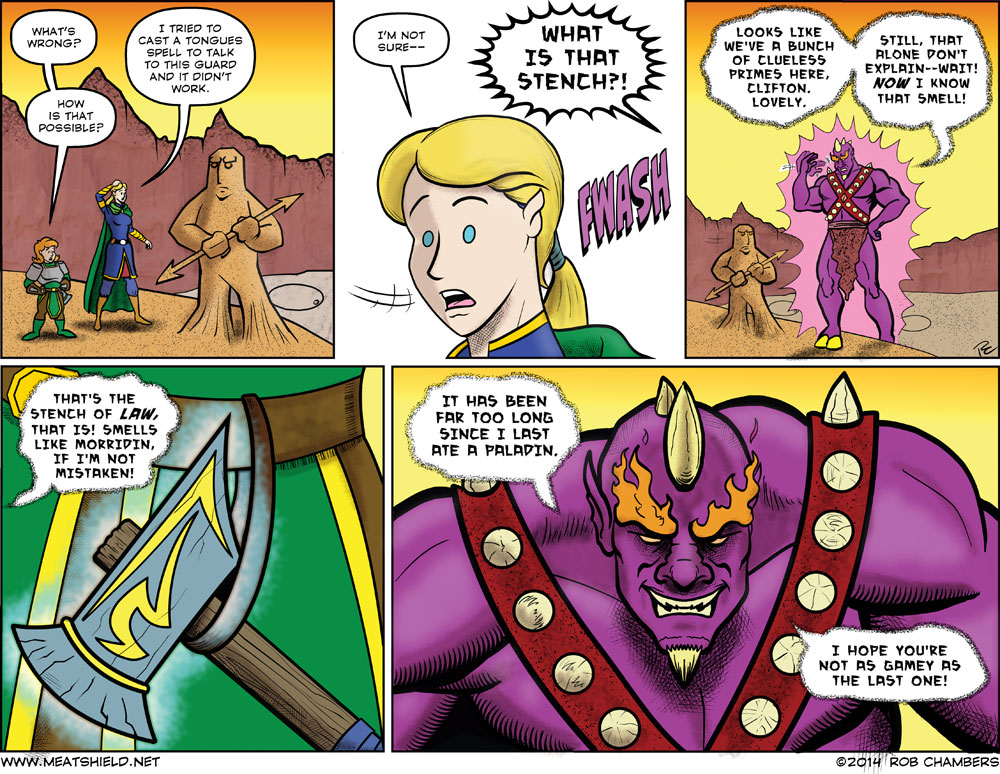
Annnnnd the hiatus is over! Man, this move took FOREVER. You never realize just how much junk you have until you have to pack it all up and move it. Especially when you have twins, which means you have duplicates of darn near everything! Ugh. Anyway, thanks for your patience, folks.
_
Strangely, paladins tend to stand out when traipsing about the planes...
Take care,
~Rob
Paladins do tend to be beacons of their dieties. No surprise they’d also attract champions of nefarious beings. You can almost see these gods placing bets on their chosen ones.
Nice twist Mr Chambers. As to what SGT Lewis said above,… to take it one step further my Paladin used to make bets with his Deity [or sometimes the Villains Deity] as to how and/or how fast he would beat the villain. Imagine a Half Orc Paladin of _____ [forgot the Dragon Deity of Mischief’s name] standing there arguing with what appears to be the air making claims as to how easily he could best the thing before him,..or telling the Villain in front of him to call upon his God and give him this message “I am going to _______ your Champion and there is nothing he [the Villain] can do about it.” then saying “and if I do I want _____” [usually some magic item of minor power that would be well within a Gods power to grant like a quiver of +1 arrows]. MY Paladin ended up with lots of small utility magic items from doing that plus a few nice addons to his weapons/armor [usually from neutral deities] that usually were reserved for other classes [like he gained wild shape once a day by defeating a Mad Druid and bringing him back to the true Druid ways or gained a”Hide in Shadows” ability by besting a Shadowmancer whose deity was a True Neutral God of Shadows]
He shouldn’t worry about the Paladin, but the CN nihilistic, genocidal Aasimar Barbarian friend of hers. She is waaaaaaay more dangerous than the Paladin.
And yes I played one in a recent campaign. And yes I was more dangerous to lower planar creatures that she was. Because I didn’t care how hurt I got as long as they were coming with me. 🙂
What is that smell, a smelly smell.. the smell of something… smelly..
I came close to breaking a palidin in a game once. We got in an arguement about good and evil and actions and intent. His position was that some actions are always evil, no matter what the intent. I asked for an example.
Palidin: Casting animate dead.
Me: Well, if you get killed in battle, we would need to bring you to a temple to have you raised, right?
Palidin: Uh, yea, I suppose. . .
Me: Well, we don’t have a cart or a horse to haul your body, and you are too heavy to carry. If we cast animate dead on you, you can walk yourself back to a temple to get fixed up.
Palidin: GET THE HELL AWAY FROM ME!!!
I personally have always been of the belief that some actions are purely evil. Going out of your way to kill innocents for example. Casting Animate Dead is, in my opinion, a little more morally ambiguous. Another example, your party is for some reason short a trapfinder (he bit the dust, is not there, never existed, etc.) and need to check a hall for the nasty buggers. You could try walking through with the 10ft pole (but seriously, who has the storage space and time to deal with that?) Or you could use one of the fresh volunteers that tried to kill you in the previous room. I can understand claiming evil when animating commoners, party members, or a good temple’s high priest; but you can’t tell me that turning the corpse of an Orc Blackguard into a zombie to use as a trapfinder/meatshield is an evil act, and I would dispute it on the following grounds:
1) He was evil in life, as a zombie he may be able to accomplish something for the greater good.
2) He was evil in life, once turned into undead, there are very few ways to resurrect you, As a zombie it makes him harder to resurrect, thereby lowering the odds he comes back to cause more evil. (Additionally, from an economic standpoint, 25 gold piece Onyx gems are a lot cheaper and easier to procure than some form of soultrap/soulbinding item, and about as reliable, as well as forcibly increasing the minimum required funding to raise the body of the evil creature, impacting the enemy’s resources and fundamentally impacting their overall equipment level… at least in theory).
3) Our hit points, or its hit points which are more valuable in saving the world (finishing the quest, etc.)
4) If we finish the quest and it is still standing, we just destroy it when we are done, and we don’t have to worry about a zombie roaming free about the countryside. I mean, no sense keeping it around after it has outlived its usefulness.
5) He is already dead and will feel no pain; meanwhile forcing us (the living party members) to suffer and take unnecessary damage is more cruel than using the bodies of the evil we’ve killed to help clear the path and take some of the pressure off the living members during battle.