
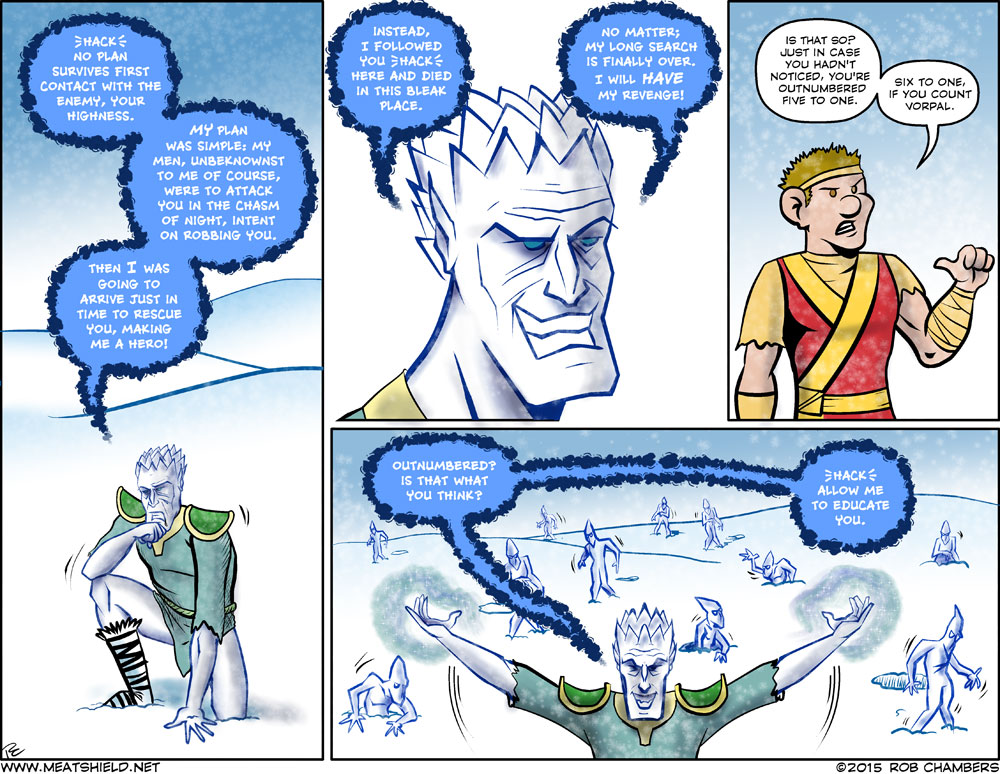
Exposition, thy name is Khalinor.
I have a large gaming group. Most games I've been in have been large groups; my very first group consisted of 8 players (we named our PCs' adventuring company "The Octagon.") My current situation has me wrangling 7 players, which presents unique challenges. For anyone out there dealing with a large group, here are some pointers I've found invaluable:
- Exploit – err, ask your players for help. If you're the DM, you know that you are essentially running the entire show: coming up with the backstory, rules adjudication, roleplaying everyone except the PCs, maintaining game balance, etc. If you can find someone to take on minor tasks like maintaining a "When last we left our heroes..." journal or acting as quartermaster for all the magic items and party gold, so much the better. In my first group, our DM and one of the players had worked out a verbal system that enabled the player to draw accurate maps of the dungeons we were in (Thanks, Steve D.!) Give out bonus XP (or if you're playing D&D 5E, Inspiration points) as incentive. Money works too.
- Don't split the party EVER. This is old advice, I know, but for a large group, it's almost vital, unless you like juggling two to three different plotlines and can keep all those balls in the air effectively. Letting the party split up can only end badly for everyone concerned, including you as the DM. The players not involved in the current plotline will get bored and get out their phones or iPads or start quoting random movies for no damn reason and this has of course never happened to me (ahem). It will end badly for the DM because you'll know that no fun was had that session. Why? Because half of the group had to wait while JoJo the Monk, Cindy the Sorcerer and Flingar the Barbarian parleyed with the goblin king while Sister Christianne the Cleric, Edrick the Knight and Totoru the Ranger were in the midst of trying not to get killed by the 14 flesh golems that you had prepared THINKING that the entire group was going to be fighting them.
- Plan waaaaaaaay in the advance. Don't make the mistake I've made more times than I can count where, in the midst of planning out the next game session, I think to myself, "3 encounters ought to do it, right? There's no way they'll be able to blast through all three of these encounters tonight! Right?" It's bitten me in the butt many times. Regardless of how much prep work you've done for your adventure, prepare at least twice that amount before you sit behind the DM screen.You never know when your players will manage to neatly circumvent the epic fight scene you had planned by simply not going down a certain hallway. It hurts when you have to shrug your shoulders and admit to your players that you have burned through everything you had prepared for that session.
- Streamline the Dice-rolling. This actually several smaller tips, but they are all huge time-savers: roll your attack and damage rolls simultaneously. If you miss, you can ignore the damage. Also, especially when you're dealing with a horde of opponents against your PCs, instead of rolling up damage for every single attack, choose the average amount (plus or minus any modifiers) and just deal that as damage. Also, pre-roll initiative for the NPCs and have all similar bad guys act on the same turn (ex. Goblins on 1, Bugbears on 12, etc.).
That's all I've got. What tips or tricks have you used?
Having too many NPCs in a combat going at once can be a problem – it can allow a lot of them to concentrate on one PC at once and take them out before they or anyone else can react. This can be a perfectly valid result, but should come from the bad guys having deliberately waited until they’re all ready before striking (either as a preplanned ambush or by delaying until the last one is ready to go) – players can feel a bit cheated when six enemies go at once, spike someone down, and get the benefit of spike damage AND of a high initiative because a single high initiative roll worked for multiple enemies.
What you could do is impose a penalty – say, -1 per member of the group – to their initiative to represent the delay due to waiting for the slowest member. That way, you get the streamlined initiative, but they’re still penalised somewhat for the benefits of coordination.
Snow goons?
Jaine – “Ch’p…?”
Ch’p – “Yeah, yeah. Learn to keep my mouth shut while in a fit of pique.”
Dhur – “I could go for a good pecan pie…”
Jaine and Ch’p – “… You know what, we’ll talk about this later.”
OK, this suggestion is for Commander Khalinor and anyone who thinks what he does on this page is a useful trick:
Summon your minions off-panel. If the good guys know that you summoned them, they will have one of two reactions, depending on how genre-savvy they are and how minions work in your edition of D&D.
First, if they are fourth-edition minions, they will have only one hit point each. Area effect spells will take them out quickly, and if they can include you in the area, you still get pounded. Then you’re all alone, again, naturally.
Second, if the minions have substantial hit points, the good guys will try to find out if doing damage to you will make them disperse. Even if they are wrong, killing you will likely make you unable to summon more, so this would still be their best option. ^_^
@Strykor: Mmm, pecan pie…
The never split the group is a huge one. Im not the dm, but we have a large group, 6 pcs, and a dm in our ponyfinder game. Of the six, only 2 have previous dnd experience. And of me and him, only he pathfinder/ponyfinder experience.
What we had done, was with the newer folks, as we had some amazing encounter luck (And why neither he or I will ever roll encounters with this group again with what we got.) But another great way to laugh it up with the pcs, let them do some of the roles that are dm like encounter chances. We had a great chuckle there lamenting the good rollers and the bad.
With our first two fights being a spider swarm (at level 1) and a giant spider the next night. (that showcased the dangers of webs and flying and why a guard is a good thing to have, even what you should do to wake folks.)
But as he was getting things shown, we talked to the folks who were unsure in part, and helped they get used to things, and also, when its not a good idea to fight with certain types and resistances. (None of us tried to pester that swarm, and ran/flew away because we couldnt touch it.)
Voice chat is amazing with large groups for net play sessions. Seriously, if six folks are typing and doing, its a huge darn bit slower, and very much less engaging than voice. Im a shy fellow, and well, even i can see the benefit with a large group to ask and let the log for rolls and what not.
It helps both get into character, and to engage the players all the more so when everyone can talk and chat like you would at a table. It makes it great for the dm as well, because of the response times are infinitely quicker.
With larger groups of PCs in combat, it pays to have a 3″x5″ card with each character’s/player’s name on it, and a couple for the monsters. (These can be generic ‘monster #1’ cards, or can have all of the monster stats on them already. Sort them into initiative order, and then just go through them, one at a time. You’ll find this allows you to go more quickly, and you can also move a card to the back if someone is delaying their action.
Having a campaign map helps a lot, too, when the players insist on going off on a ‘side quest’ – it can be fairly simple, with pretty plain markings of rivers, mountains, and towns, and so on. Or it can be just a single city, if that’s where the players are going to be for the whole adventure.